

Daytona Beach Roofing repairs wind, hail, and hurricane damage on homes and businesses across Volusia and Flagler Counties. Call (386) 564-6700 and we start with emergency tarping if water is getting in, then a free inspection with photos you can hand to your insurance company. We are a licensed Florida roofing contractor based on International Speedway Boulevard, so you are calling the same local company for tarping today that you can call for repairs, questions, or a warranty issue next month.
Or call (386) 564-6700
Stay off the roof. Wet shingles and loose decking are slippery and weaker than they look, and a fall causes more harm than any leak will.
Take photos before you clean anything up. Shoot the ceiling stains, the wet insulation, the shingles in the yard, the dented gutters. Your adjuster will want to see the damage as the storm left it, and once you start tidying, that record is gone.
Move furniture and electronics out from under any drip and put a bucket down. If water is coming through the ceiling, poke a small hole at the lowest point of the bulge so it drains into the bucket instead of spreading across the drywall.
Then call us. If the roof is open, we send a crew to tarp it. If it is holding for now, we schedule the inspection. Our emergency roof repair line is the same number as the office: (386) 564-6700.
Some of it is obvious from the driveway. A lot of it is not.
Wind damage on asphalt shingles usually shows up as creased or lifted tabs before any shingle actually blows off. The seal strip breaks, the shingle flaps in the next gust, and water gets under it. From the ground the roof can look fine.
Hail leaves round bruises where the granules are knocked loose. You feel them before you see them. Granules in the gutters and downspouts after a storm are a sign worth mentioning when you call.
Debris does the blunt work. A limb that hits a roof can crack tile, puncture shingles, and split the decking underneath. Flashing around chimneys, vents, and skylights bends and pulls away, which is where most storm leaks start on otherwise intact roofs.
Inside the house, look for water stains on ceilings and around the tops of walls, a musty smell in a closet under the roofline, and wet insulation in the attic. Any of those means water is already past the roof.
We wrote up the full list of signs, with what each one usually means, in our storm damage guide.
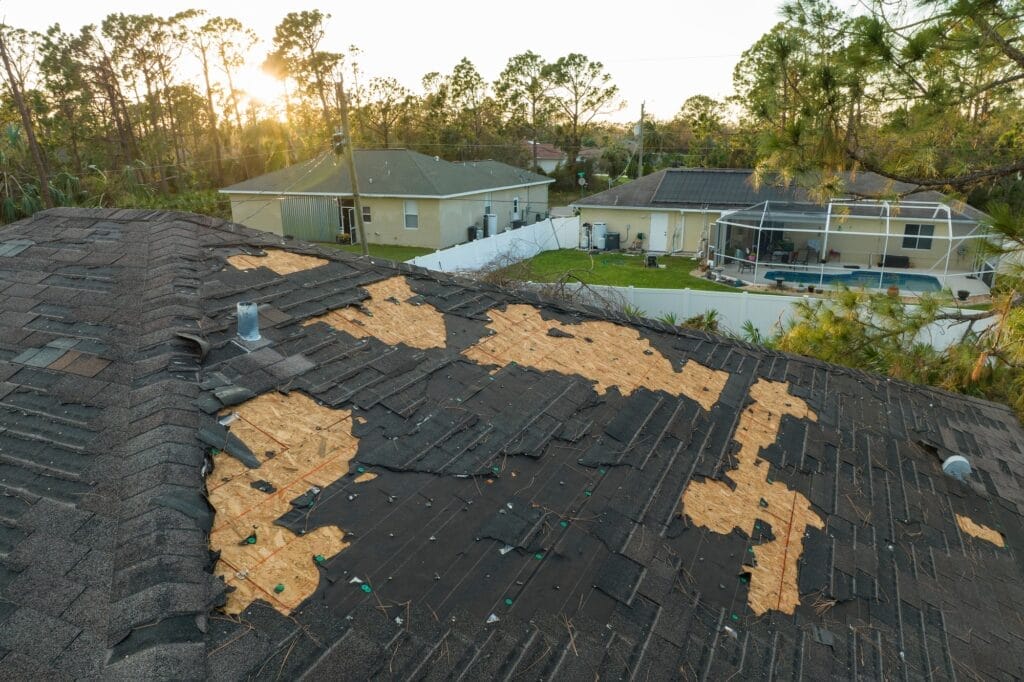
Daytona Beach Roofing documents storm and wind damage, provides a written inspection report, and works directly with your homeowners insurance adjuster to support your claim. We do not file the claim for you. That stays between you and your insurer. We handle every part of the process that requires a roofing professional’s assessment.
Free inspection and photo documentation of the damage
Written damage report you can submit to your insurance company
We meet your adjuster on-site if scheduled, to point out damage that is easy to miss from the ground
Once your claim is approved, we schedule the repair or replacement and handle Volusia County permitting
Once your claim is approved, we schedule the repair or replacement and handle Volusia County permitting.
One honest note: not every storm-damaged roof is a claim. If the damage is minor, or your deductible is close to the repair cost, we will tell you that at the inspection, before you file anything. This page describes our standard claims-support process and is not insurance or legal advice. Your policy terms and your adjuster’s findings govern the outcome of any claim.
Tarping is a stopgap. Its whole job is to keep more water out until the roof can be assessed and repaired properly. Our crew covers the damaged section with heavy sheeting and fastens it at the edges so the next band of rain does not get in.
A tarp does not fix anything. Once it is on, we come back for the full inspection, put the findings in writing, and go from there. Leaving a tarp on for months invites its own problems, so treat it as the first step, not the last.
A repair makes sense when the damage is isolated: a few lifted shingles on one slope, a bent piece of flashing, one puncture from a limb. A replacement makes sense when the damage is spread across the roof, the roof was near the end of its life before the storm, or the decking is compromised in more than one place.
Florida’s building code adds a rule of its own. When 25 percent or more of a roof section is repaired, replaced, or recovered, that section generally has to be brought up to the current code. Roofs that were built, repaired, or replaced to the 2007 Florida Building Code or later are exempt, so only the repaired portion has to comply (Florida Statute 553.844(5), amended by Senate Bill 4-D in 2022). The age of your roof changes the answer, and we check it before we recommend anything.
Our inspection report says which option we recommend and why, in plain language. If a repair is the right call, we say so.

After a big storm, roofing crews from other states arrive in Volusia County for a few weeks and leave. Some do fine work. The trouble comes later, when a permit was never pulled, the wind-uplift nailing pattern does not match what the Florida Building Code requires for this wind zone, or the warranty phone number rings in another time zone.
Daytona Beach Roofing holds Florida roofing contractor license CCC1336785. We pull Volusia County permits for the work that needs them and schedule the inspections. Our office is at 132 W International Speedway Blvd, Suite 7, in Daytona Beach. When the storm coverage ends, we are still here.
We handle storm damage roof repair throughout Volusia County, including Daytona Beach, Daytona Beach Shores, South Daytona, Ponce Inlet, Ormond Beach, Ormond-by-the-Sea, Holly Hill, Port Orange, New Smyrna Beach, Edgewater, DeLand, Deltona, Orange City, and DeBary, plus Flagler County up to Palm Coast and the Sanford area of Seminole County. Not sure if you are in range? Call and we will tell you.
Or call (386) 564-6700.
