


Not insurance or legal advice. This article explains how Florida homeowners insurance generally treats roof damage and roof age, based on Florida statutes current as of September 2026. Your own policy, your insurer’s underwriting rules, and your adjuster’s findings decide what happens with your claim. Confirm coverage details with your insurance company or agent before you rely on anything here.
Direct Answer
In Florida, homeowners insurance typically covers roof replacement when a covered peril, such as wind, hail, a hurricane, or a falling tree, causes the damage. It typically does not cover a roof that simply wore out from age or lack of maintenance. Between those two, the details come down to your specific policy: what perils it names, what deductible applies to the roof, and whether it pays actual cash value or full replacement cost. The sections below walk through the Florida rules that shape those details.
What Florida Policies Usually Cover And Exclude
A standard homeowners policy covers sudden, accidental damage from a listed peril. Wind ripping off shingles during a storm is a covered event. A roof that gradually deteriorates from age, sun, and humidity is generally treated as a maintenance issue, not a covered loss, the same way a policy would not pay to replace worn carpet.
That distinction is why two roofs in the same neighborhood can get different answers after the same storm. If an adjuster can trace missing shingles or cracked tiles to wind or hail, that is usually a claim. If the roof was already failing before the storm, the insurer may treat some or all of the damage as pre-existing wear rather than storm loss.
This is general policy structure, not a substitute for your declarations page. Some Florida policies exclude specific perils, cap certain claim types, or handle cosmetic damage differently. Read your policy or ask your agent what your specific exclusions are before you assume coverage either way.
Replacement Cost Vs Actual Cash Value For Roofs
When an insurer pays a roof claim, it pays one of two ways: replacement cost, which covers what a new roof actually costs, or actual cash value (ACV), which subtracts depreciation for the roof’s age and condition. A 20-year-old roof paid on an ACV basis gets a smaller check than the same damage on a newer roof, even though the repair costs the same either way.
Florida law lets insurers apply a separate roof deductible. Under Florida Statute 627.7011(3)(a), once that roof deductible applies, “the insurer may limit the claim payment as to the roof to the actual cash value of the loss to the roof until the insurer receives reasonable proof of payment by the policyholder of the roof deductible.” In plain terms: your insurer can hold the payment at ACV until you show you’ve paid your share.
Whether your policy pays ACV or full replacement cost on the roof, and what your roof deductible is, is on your declarations page. If you don’t have it in front of you, your agent can pull it in a few minutes.
The 15-Year Rule And Roof Age
Florida law limits how insurers can use roof age against you. Under Florida Statute 627.7011(5), “an insurer may not refuse to issue or refuse to renew a homeowner’s policy insuring a residential structure with a roof that is less than 15 years old solely because of the age of the roof.”
For a roof 15 years or older, the same statute gives you an out: “the insurer may not refuse to issue or refuse to renew a homeowner’s insurance policy solely because of roof age if an inspection of the roof of the residential structure performed by an authorized inspector indicates that the roof has 5 years or more of useful life remaining.” The statute also requires the insurer to let you get that inspection done at your own expense before it can require a roof replacement as a condition of coverage.
That last point matters if you’ve gotten a non-renewal notice over roof age. A qualified inspection showing five-plus years of remaining life is your leverage to keep the policy. We document roof condition as part of every inspection we do, and a homeowner can take that report to their insurer or agent.
Deadlines To Report A Claim In Florida
Florida sets hard deadlines for reporting property damage, and missing one can end a claim before it starts. Under Florida Statute 627.70132, a new claim “is barred unless notice of the claim was given to the insurer…within 1 year after the date of loss.” A supplemental or reopened claim, filed after the insurer has already responded to the original one, has to reach the insurer within 18 months of the date of loss.
If your property is part of a condo or HOA and you’re filing a loss-assessment claim, the deadline runs from either one year after the loss or 90 days after the association votes to levy the assessment, whichever is later.
These are the current deadlines as of the statute’s most recent amendment. They have changed before, so if your storm damage happened more than a few months ago, don’t assume you still have time. Check with your insurer or agent now rather than later.
How A Roofing Contractor Fits Into The Claim
Daytona Beach Roofing documents storm and wind damage, provides a written inspection report, and works directly with your homeowners insurance adjuster to support your claim. We do not file the claim for you. That stays between you and your insurer, and you decide when and how to submit it.
One thing Florida law changed in recent years: a contractor can no longer take over your claim the way some used to. Since January 1, 2023, Florida Statute 627.7152 makes it so “a policyholder may not assign, in whole or in part, any post-loss insurance benefit” under a residential property policy, and any such assignment attempt is “void, invalid, and unenforceable.” That means you stay the one dealing with your insurer, with your contractor supporting the claim rather than standing in for you.
In practice, that support looks like: a free inspection with photo documentation, a written report you can hand to your insurance company, and someone who can walk the roof with your adjuster if a site visit gets scheduled. What we can’t do, by law, is take your claim off your hands.
If a storm caused the damage, see our storm damage roof repair page for what to do in the first 24 hours. For a full walkthrough of what to expect from start to finish, see How Does a Roof Insurance Claim Work.
When A Replacement Is Required Even Though A Repair Would Do
Sometimes the building code decides for you. Under Florida Statute 553.844(5), when a roof was built, repaired, or replaced to the 2007 Florida Building Code or a later edition, and 25 percent or more of a roofing system or roof section is being repaired, replaced, or recovered, only that repaired or recovered portion has to meet the current code. Local governments can’t require more than that through their own ordinances.
If your roof already meets the 2007 code or newer, storm damage limited to one section usually only brings that section up to current standards. If your roof predates that code, or if the damage spans more than a quarter of a roof section, you may be looking at a full re-roof to stay code compliant, insurance question aside. We check your roof’s code history as part of the inspection and tell you which situation applies before recommending a repair or a replacement.
Programs That Can Help
Florida runs My Safe Florida Home, a state program that has offered free wind-mitigation inspections and matching grants toward hardening a home, including roof-related upgrades, to eligible homeowners when the program has funding available. Funding and eligibility change from year to year, so ask your agent or check the state’s program directly for current status before counting on it. We won’t promise funding we can’t confirm.
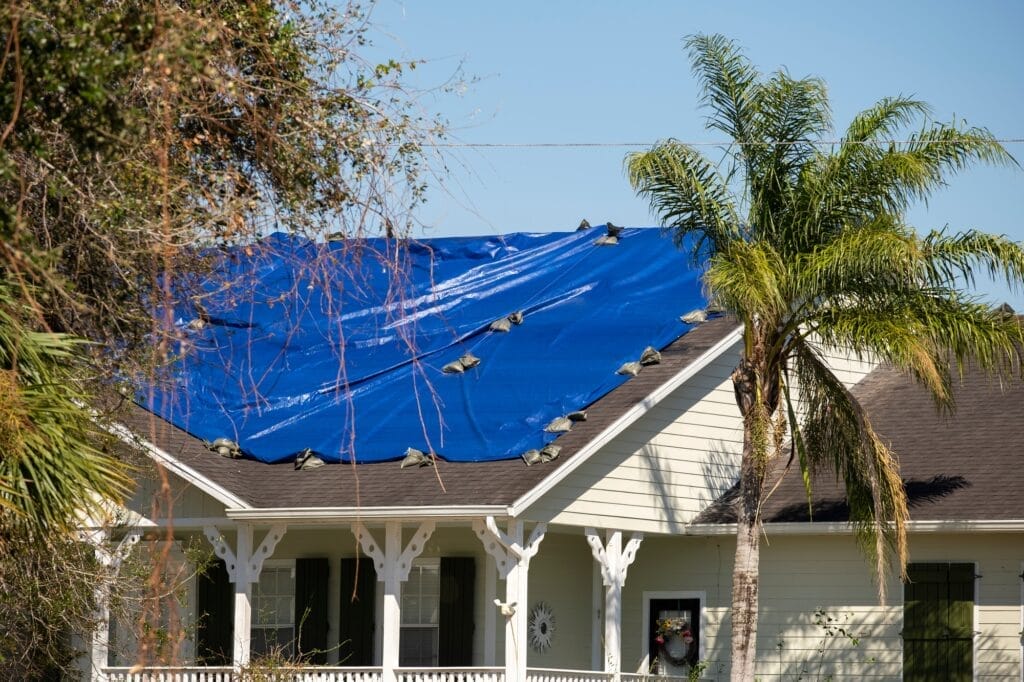
After a federally declared disaster, FEMA and the U.S. Army Corps of Engineers sometimes run Operation Blue Roof, which installs temporary blue plastic sheeting over storm-damaged roofs for eligible homeowners. It’s a stopgap to keep water out, not a roof replacement, and it doesn’t substitute for filing an insurance claim or scheduling a permanent repair.
Frequently Asked Questions
Does homeowners insurance cover a roof replacement in Florida?
Usually, if a covered peril like wind, hail, or a fallen tree caused the damage. A roof that failed from age or lack of maintenance is typically not covered. Your policy’s specific perils and exclusions control the outcome.
Can my insurance company drop me because my roof is old?
Not solely for that reason if the roof is under 15 years old. For roofs 15 years or older, Florida law (627.7011(5)) lets you get an inspection at your own expense; if it shows 5 or more years of useful life left, the insurer can’t refuse to issue or renew the policy solely over roof age.
What’s the difference between actual cash value and replacement cost for a roof claim?
Replacement cost pays what a new roof costs. Actual cash value pays that amount minus depreciation for age and condition, so it’s a smaller check on an older roof. Florida law also lets insurers hold roof claim payments at actual cash value until you’ve paid your roof deductible.
How long do I have to file a roof damage claim in Florida?
One year from the date of loss for a new claim, and 18 months from the date of loss for a supplemental or reopened claim, under Florida Statute 627.70132. Loss-assessment claims from a condo or HOA have their own rule tied to when the association votes on the assessment.
Can a roofing contractor file my insurance claim for me?
No. Since 2023, Florida law bars assigning your post-loss insurance benefits to a contractor. A roofing contractor can inspect the damage, document it in writing, and meet your adjuster on-site, but you file and control the claim.
Do I have to replace my whole roof if only part of it was damaged?
Not automatically. Under the state’s 25 percent rule, if your roof already meets the 2007 Florida Building Code or later, damage to one section generally only requires that section to be brought to current code. An older roof, or damage spanning more than a quarter of a section, can push the project toward a full replacement.
Get A Documented Inspection Before You File
If a storm hit your roof, get it inspected and documented before you decide anything with your insurer. Call Daytona Beach Roofing at (386) 564-6700, or request a free inspection online, and we’ll give you a straight answer on what we see, in writing.
Written by the Daytona Beach Roofing team. Insurance sections reviewed by Todd Romazko, Florida-licensed insurance adjuster (License #E141454).
Sources
- Florida Statute 627.7011(5), roof age, the 15-year rule, and the inspection requirement
- Florida Statute 627.7011(3)(a), roof deductible and actual cash value hold until the deductible is paid
- Florida Statute 627.70132, notice of claim deadlines: 1 year for a new claim, 18 months for a supplemental claim
- Florida Statute 627.7152, ban on assignment of post-loss insurance benefits, effective January 1, 2023
- Florida Statute 553.844(5), the 25 percent roof repair/replacement rule and the 2007 Florida Building Code exemption
